
Database connections: engines and PHP drivers
A connection has two independent choices:
- the database engine — the product that stores the data (MySQL / MariaDB, PostgreSQL, SQLite);
- the PHP driver — the PHP extension used to talk to it (PDO, MySQLi, or the CodeIgniter database layer).
PDO and MySQLi are drivers, not engines: PDO is one API with a sub-driver per engine (pdo_mysql,
pdo_pgsql, pdo_sqlite), while MySQLi only speaks MySQL / MariaDB. The GUI therefore asks for both and only
enables the drivers that are installed on the server.
Supported combinations
Section titled “Supported combinations”| Engine | PDO | MySQLi | CodeIgniter 4 driver |
|---|---|---|---|
| MySQL 5.7+ / MariaDB 10.3+ | Yes, pdo_mysql |
Yes, mysqli |
Yes, MySQLi |
| PostgreSQL 11+ | Yes, pdo_pgsql |
— | Yes, Postgre |
| SQLite 3.26+ | Yes, pdo_sqlite |
— | Yes, SQLite3 |
| Microsoft SQL Server | not supported yet | — | not supported yet (SQLSRV) |
| Oracle | not supported yet | — | not supported yet (OCI8) |
Status of the test suite: SQLite (PDO) and MySQL 8.4 (PDO, MySQLi and CodeIgniter MySQLi) are covered by
automated tests. The PostgreSQL code paths (introspection through information_schema / pg_catalog,
ILIKE, RETURNING) are implemented but were not run against a live server in this release — please
report issues.
Which driver should I pick?
Section titled “Which driver should I pick?”- PDO is the default and the recommended choice for every engine: one consistent API, real prepared statements (emulation is disabled for MySQL), native int/float results.
- MySQLi is an equivalent alternative for MySQL / MariaDB, useful on hosts where
pdo_mysqlis not installed. Queries are prepared statements as well and numeric columns are returned natively (MYSQLI_OPT_INT_AND_FLOAT_NATIVE). - CodeIgniter group (CodeIgniter only) reuses
app/Config/Database.php, so the API and your application share one configuration. Bindings are escaped by CodeIgniter.
There is no functional difference for the API between the drivers: the same SQL grammar, schema introspection and error mapping are used for a given engine.
Where connections come from
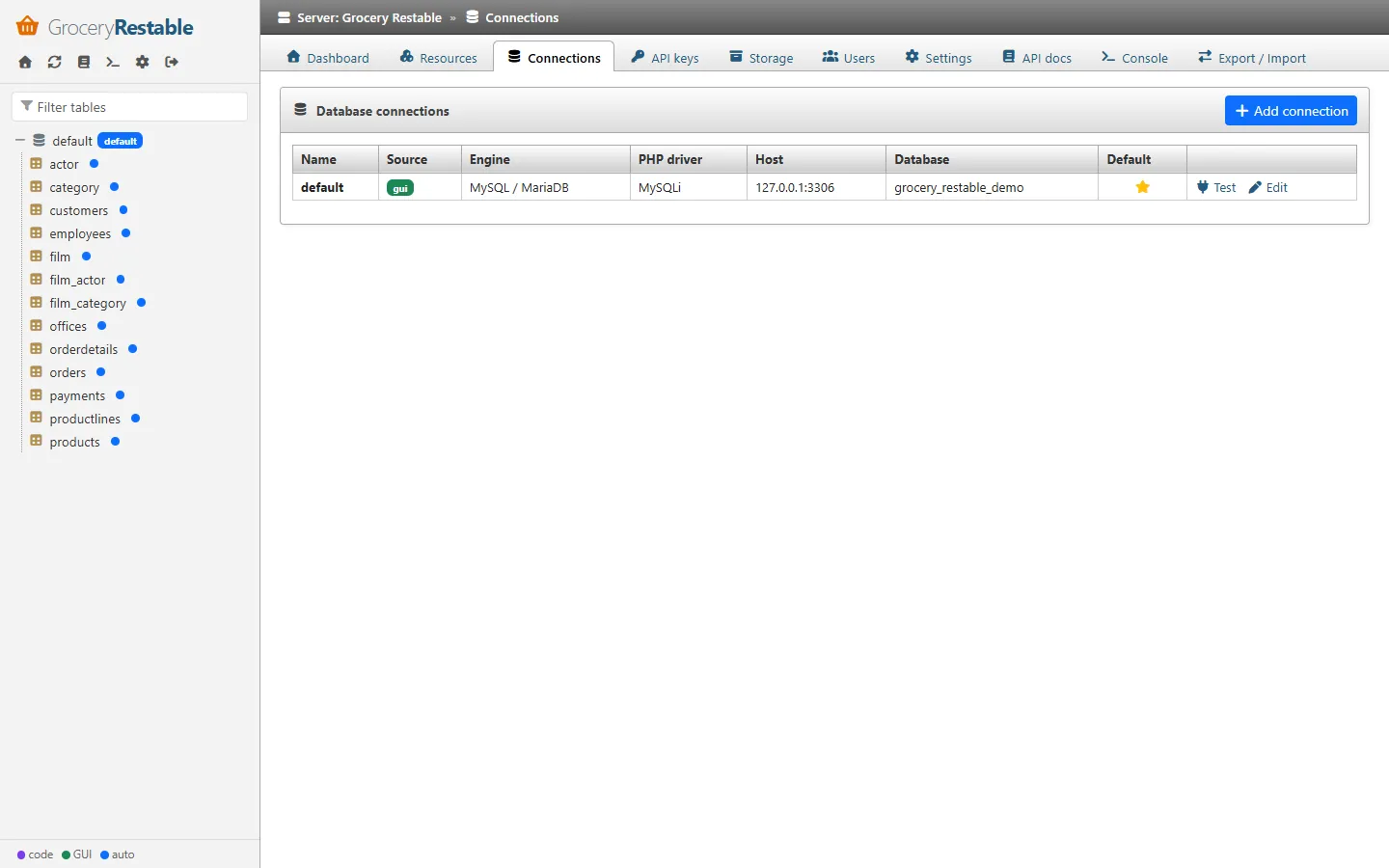
Section titled “Where connections come from”| Source | Defined in | Editable in the GUI |
|---|---|---|
framework |
CodeIgniter: $databaseGroups in app/Config/GroceryRestable.php |
no (read-only) |
gui |
Setup wizard or Connections page, stored in SQLite (password encrypted) | yes |
| code | $api->addConnection($name, fn () => new PdoConnection($pdo)) |
no |
The default connection is used by auto expose and by resources without setConnection(). Change it on the
Connections page (star icon).
Connection definition
Section titled “Connection definition”Stored connections use this structure (also accepted by ConnectionFactory::make()):
// MySQL / MariaDB with PDO['driver' => 'mysql', 'client' => 'pdo', 'host' => '127.0.0.1', 'port' => 3306, 'database' => 'shop', 'username' => 'api', 'password' => '…', 'charset' => 'utf8mb4']
// MySQL / MariaDB with MySQLi['driver' => 'mysql', 'client' => 'mysqli', 'host' => 'db', 'database' => 'shop', 'username' => 'api', 'password' => '…']
// PostgreSQL['driver' => 'pgsql', 'client' => 'pdo', 'host' => 'db', 'port' => 5432, 'database' => 'shop', 'username' => 'api', 'password' => '…', 'schema' => 'public', 'sslmode' => 'require']
// SQLite['driver' => 'sqlite', 'client' => 'pdo', 'database' => '/var/data/shop.sqlite']
driver is the engine (kept as driver for backward compatibility), client the PHP driver (default pdo).
Invalid combinations (e.g. PostgreSQL + MySQLi) and missing extensions are rejected with a clear message.
Multiple databases
Section titled “Multiple databases”Add more connections in the GUI or in $databaseGroups, then bind resources to them:
$api->resource('invoices')->setConnection('billing');In the GUI, every connection appears in the navigation tree; the API resource tab of a table stores the connection automatically. Relations always stay inside one connection.
Schema cache
Section titled “Schema cache”Table structures are introspected once and cached in SQLite. Every request runs one cheap fingerprint query
(MySQL: a checksum of information_schema columns and keys; PostgreSQL: an MD5 of the columns plus the key count;
SQLite: PRAGMA schema_version). When it changes — a table, column or key was added, renamed or altered — the schema
is introspected again immediately, so migrations are visible on the next request. schema_cache_ttl (default 300 s)
is only an upper bound. You can still force a refresh with the refresh icon in the navigation, Settings → Clear
schema cache, php spark grocery-restable:cache or $api->schema()->refresh().
Database user permissions
Section titled “Database user permissions”Grant the API database user only what the API needs (SELECT, INSERT, UPDATE, DELETE on the exposed
tables). Introspection reads information_schema (MySQL, PostgreSQL) / sqlite_master (SQLite), which every
user can read for the tables it has access to.